
Supply Chain Orchestration is the missing layer between seeing a disruption and executing the optimal response turning visibility into proactive action. On March 23, 2021, the Ever Given container ship wedged sideways in the Suez Canal, blocking $400 million in trade per hour for six days. While post-mortems focused on maritime risk and canal dependencies, the operational reality for manufacturers was more visceral: most didn’t know they had exposure until their warehouses called to report a stockout.
What the Ever Given exposed wasn’t a shipping problem, it was a coordination problem. Despite billions invested in ERPs and real-time tracking, a fundamental gap remains between knowing there is a disruption and executing the optimal response. This gap between visibility and orchestration is the primary driver of supply chain waste for the modern manufacturer.
The Coordination Tax: Quantifying the Blind Spot
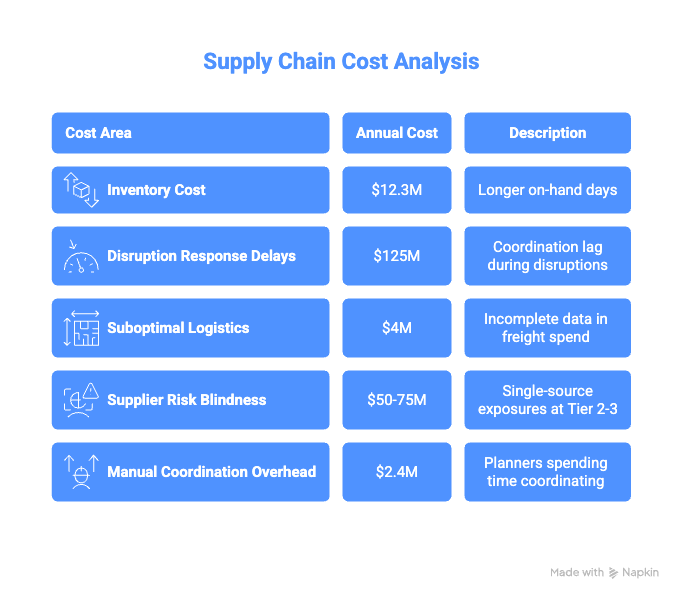
For a $5 billion manufacturer, the lack of automated decision-making creates measurable waste across three primary categories:
- Disruption Response Delays: In a typical manual environment, the average coordination time from alert to executed response is five days. Between investigating impact across fragmented systems (ERP, TMS, production schedules) and holding cross-functional meetings for approval, the daily cost of lag including expedited freight and production downtime averages $500,000 per disruption.
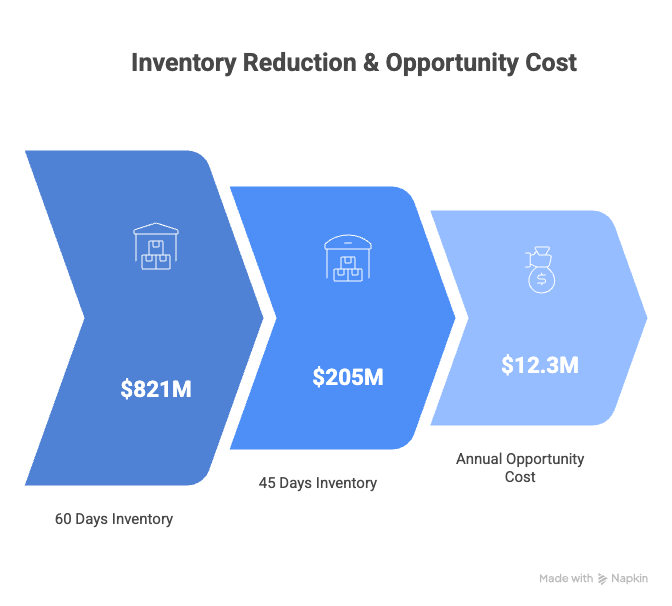
- Inventory Inefficiency: U.S. manufacturers hold an average of 60 days of inventory. Digitally mature peers operate at 45 days. This 15-day delta represents $205 million in tied-up working capital for a $5B firm. The difference isn’t manufacturing speed; it’s the speed at which demand signals are coordinated with supply actions.
- Suboptimal Logistics Selection: Approximately 10% of logistics decisions are made with incomplete data. Without real-time visibility into whether a customer delivery can absorb a delay, managers often default to expensive air freight (“panic shipping”) when alternative inventory or buffer time actually exists.
Why Infrastructure Alone Fails to Deliver Speed
The industry has spent two decades building a robust digital stack, yet the “Decision Operating System” remains missing. This is precisely the Supply Chain Orchestration gap: visibility without coordinated execution.
- Systems of Record (ERP/TMS/WMS): These systems excel at digitizing transactions and optimizing domain-specific silos. However, when a shipment is delayed, no ERP automatically decides whether to reroute or delay production. That remains a manual human intervention.
- Visibility Platforms (Control Towers): These platforms provide real-time tracking and predictive ETAs. They show you the fire in high definition, but they do not coordinate the fire trucks. The manager receives the alert and then spends 48 hours manually coordinating the response across departments.
The bottleneck has shifted from data scarcity to cognitive overload. The supply chain manager is now the “human API,” manually stitching together insights from five different dashboards to make a single trade-off decision.
The Avaloka Approach: Closing the Gap
Avaloka does not seek to replace the existing stack. Instead, it functions as the orchestration layer sitting above it. By implementing a multi-agent AI architecture, the platform transitions supply chain management from reactive monitoring to proactive execution. Avaloka acts as a Supply Chain Orchestration layer above ERP, TMS, and control towers.
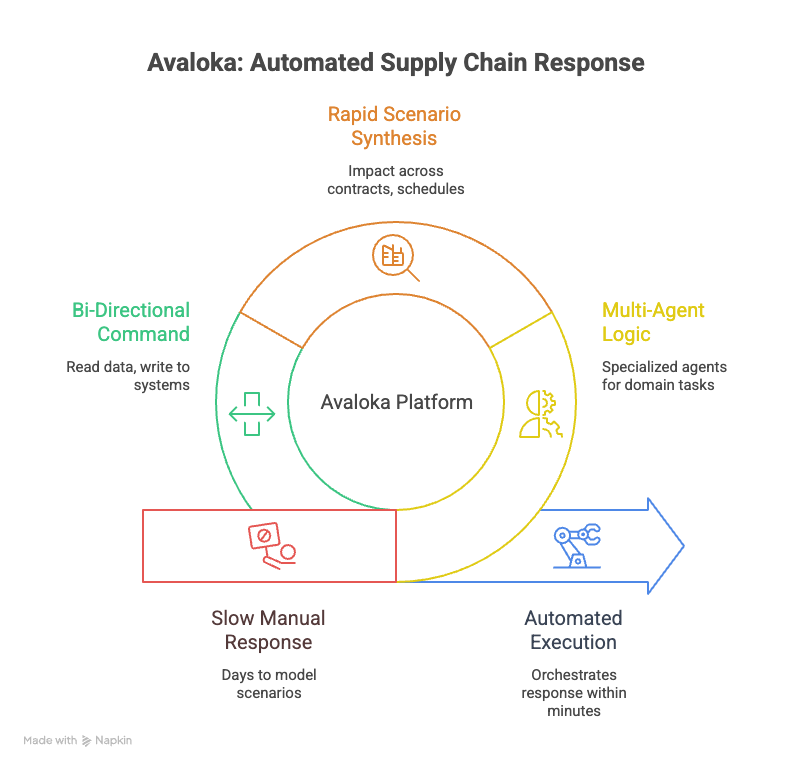
1. Multi-Agent Decision Logic
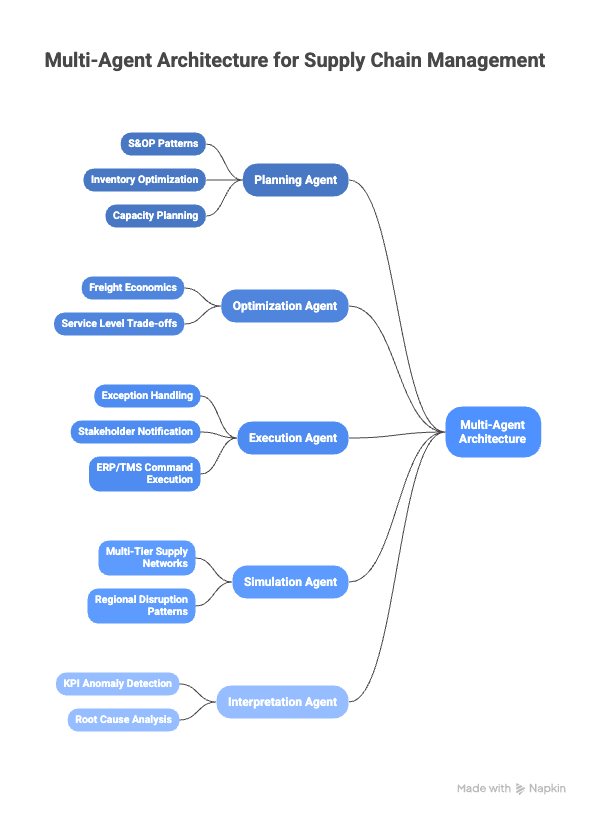
Unlike single-model AI, Avaloka utilizes specialized agents with domain-specific authority:
- Planning Agent: Reconciles demand-supply signals and capacity.
- Optimization Agent: Calculates logistics trade-offs and freight economics.
- Execution Agent: Triggers workflows directly within ERP and TMS environments.
2. From Alert to Execution in Minutes
In the event of a disruption such as the Red Sea rerouting the traditional manual response takes days to model scenarios in Excel and secure executive buy-in. Avaloka’s agents synthesize the impact across customer contracts, production schedules, and freight costs simultaneously, presenting a recommended “optimal path” for approval within minutes.
3. Bi-Directional Command
The structural advantage of Avaloka lies in its ability to not only read data but to write it. Once a decision is approved, the platform orchestrates the response: booking the freight, updating the production schedule in the ERP, and notifying the warehouse and customers ensuring the digital plan and physical reality remain synchronized.
The Economic Imperative
The manufacturers that will dominate the next decade are not those with the most data, but those with the highest “Decision Velocity.” Reducing the time-to-decision from days to hours eliminates the coordination tax that currently erodes margins.
Avaloka provides the nervous system that turns visibility into action, ensuring that when the next global disruption occurs, your supply chain doesn’t just see it, it responds to it.
Discover more at AVALOKA
Avaloka #SupplyChainOrchestration #EnterpriseAI #AgenticAI #DecisionIntelligence #AIOrchestration #Manufacturing #Logistics #SupplyChainVisibility #Automation